Memorial and Continuing Bonds · 8 min read · October 23, 2026
By the StayWith team
20 Pet Memorial Ideas That Actually Bring Comfort
The memorial that brings comfort is rarely the most expensive one. It is the one you will actually encounter in ordinary life: a photo where they used to sit, a candle lit on a hard evening, their name spoken in the garden. Below are 20 ideas that grieving owners say genuinely helped, grouped by kind and marked for effort and cost. Choose one that fits the shape of your days, not the size of your grief.
Which memorials can I make at home?
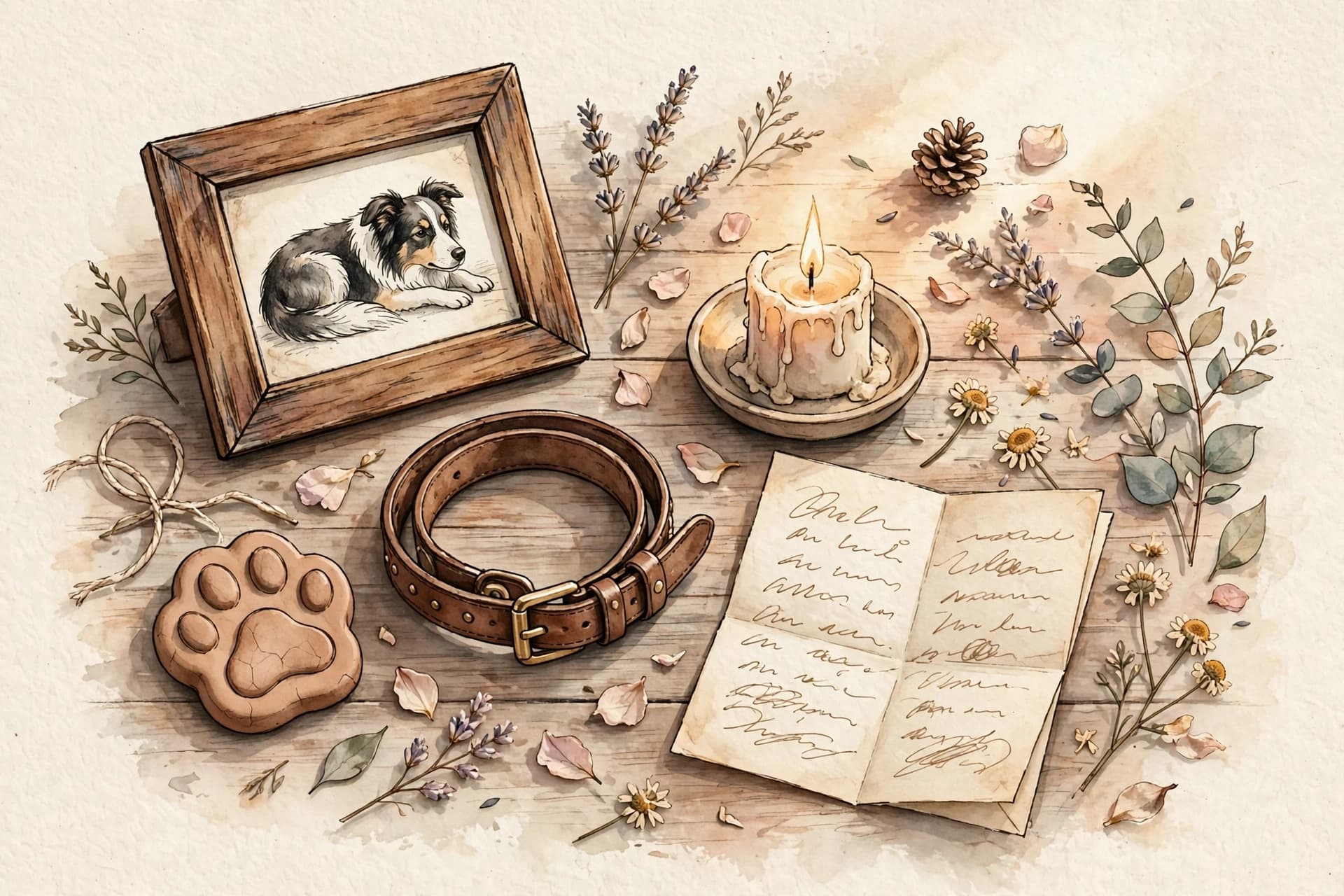
Building a memorial corner takes ten minutes and three decisions. First, choose the spot by the moment that hurts most: by the door if coming home is hardest, by the sofa if the evenings are. Second, choose three objects at most, a photo, the collar, and one small thing that was theirs, because a crowded shelf feels like clutter and a simple one feels like a shrine. Third, put the photo at eye level, not on a high shelf, so you meet their eyes without reaching. Light the candle at the same time each week if you use one, because the ritual of the time matters as much as the flame. Leave the corner alone after that. It will do its work quietly, every day, without you having to tend it.
- A memorial corner. A small shelf or side table with their photo, collar, and a candle. It gives grief a place to live so it does not spread over the whole house. Effort: low. Cost: none to low.
- A framed photo where they used to wait. Put it by the front door, their sofa spot, or the kitchen doorway. Meeting their eyes in the old place is strangely steadying. Effort: low. Cost: low.
- A weekly candle ritual. Light a candle on the same evening each week, say their name, and let anyone in the house share one memory. Ritual turns missing them into something you do, not only something that happens to you. Effort: low. Cost: none.
- Their blanket, kept where it belongs. Folded on the arm of the sofa or at the end of the bed, unwashed for as long as you need. Scent fades slowly, and by the time it does, you are usually readier than you feared. Effort: none. Cost: none.
- A memory jar. A jar and slips of paper on the table for the first month. Whenever a memory surfaces, write it down and drop it in, then read them all on their birthday. Effort: low. Cost: none.
What keepsakes can I hold on to?
If you want a paw print, ask before the cremation, because it must be made while the body is still with the vet or the crematorium. Most practices offer a clay print for a small fee, and some include it without asking. An ink print on card is simpler and keeps well in a frame. For a fur clipping, ask the vet or the crematorium to save a small lock during their care, or cut one yourself in the first days, from behind the ear where the fur is softest, and keep it in a labelled envelope. These are the two keepsakes owners most often say they wish they had arranged, and both take one sentence to ask for.
- A paw print. Vets and crematoriums often offer a clay or ink print, and home kits cost little. If your pet is still with you and elderly, making one now is a kindness to your future self. Effort: low. Cost: low.
- A clipping of fur. A small lock kept in an envelope, a locket, or a tiny glass vial. It is the oldest keepsake of all and still the one people mention most. Effort: low. Cost: none to low.
- A collar shadow box. Their collar, tag, and one good photo arranged in a deep frame. It turns objects that hurt to stumble across into something honored and finished. Effort: medium. Cost: low to medium.
- Their name tag on your keyring. Small, private, and with you everywhere. Many owners say the soft clink of the tag is the point. Effort: none. Cost: none.
- Ashes kept or scattered with intention. A simple urn at home, or scattering at their favorite walk on a chosen day with the people who loved them. The ceremony matters more than the container. Effort: medium. Cost: varies.
What living memorials grow over time?
- Plant a tree or a sturdy shrub in their name. Choose something that flowers near their birthday if you can. Watching it grow gives grief a forward direction. Effort: medium. Cost: low to medium.
- A garden stone with their name. Painted by hand or engraved, placed where they liked to lie in the sun. Children especially find a stone reassuring, because it gives them somewhere to go and talk. Effort: low. Cost: low.
- Donate or sponsor in their name. A gift to the shelter they came from, or sponsoring a kennel for a month. Their love keeps feeding other animals, which is exactly what they would have voted for. Effort: low. Cost: your choice.
- Keep walking their route. On anniversaries, or every Sunday, walk the old walk without a lead in your hand. The first one is brutal. Later ones often become peaceful hours. Effort: low. Cost: none.
What can I make with art and words?
- Commission a portrait from a favorite photo. Many artists work from a single photograph and capture the exact expression you miss. Choose the photo that looks like them on an ordinary day, not the most beautiful one. Effort: low. Cost: medium to higher.
- Write them a letter. Thank them, tell them what you are sorry for, tell them what you are doing with their spot on the sofa. Letters let you say the unsaid, which is where much of the ache lives. Effort: low. Cost: none.
- Frame the Rainbow Bridge poem beside their photo. The poem promises they are whole, waiting, and watching for you, which is why it sits on so many memorial shelves. Our page on the Rainbow Bridge poem prints the full text and the story of its real author. Effort: low. Cost: low.
What digital memorials exist now?
- Make a photo film. Their photos in order, puppy to grey muzzle, set to one song that was always playing in your house. Ten minutes to make, and it becomes the thing you show people who never met them. Effort: medium. Cost: none.
- Create an online memorial page. Several sites let you build a page with photos, dates, and their story, and visit it from anywhere. Some families gather there on anniversaries and leave messages. Effort: low. Cost: none to low. Our article on keeping your pet close gathers more ways people hold on to a pet's presence.
- Keep them on your desktop. StayWith (staywith.pet) turns a few photos of your pet into a small 3D version of them that lives on your Mac desktop. It walks along your dock, naps on your open windows, and watches your cursor as you work. It is a likeness, not a replacement, and for people who spent every working day with a pet beside them, glancing down and seeing them there is a quiet, daily comfort. Effort: low. Cost: fixed price after a free preview.
How do I choose the right one?
Start with the moment of the day that hurts most. If it is coming home, choose something at the door. If it is the evening, choose the candle or the corner. If it is working in silence, choose something for your desk. You can also choose in stages, because grief changes: many people begin with the blanket and the photo, and add the tree or the portrait months later, when the early rawness has softened. For words to put with whatever you choose, our collection of dog passed away quotes includes card wording that actually sounds human.
How much does a pet memorial cost?
Almost nothing, if you want it to. The memorials owners say helped most are usually the free ones: the photo by the door, the blanket kept where it belongs, the weekly candle, the walk on the old route. A simple framed print costs about 10 to 30 dollars, a deep shadow box frame about 20 to 50, and a clay paw print kit about 15 to 30. Commissioned portraits are the biggest jump, often 50 to 200 dollars for a digital portrait and more for oil or watercolour, depending on the artist. Engraved garden stones run about 20 to 60 dollars, and a planted tree about 30 to 80 depending on size. A good rule is to spend where you will see it every day and save where you will not. A 15 dollar frame on the shelf by the door brings more comfort than a 200 dollar object kept in a drawer, because comfort comes from encounter, not from price.
When should I make the memorial, and what if I am not ready?
There is no right week. Some people need something in place within days, because the empty house is unbearable and a small shelf with a photo gives the grief somewhere to sit. Others cannot face it for months, and that is normal too. If you are not ready, do not force it. Put their things in one box, a collar, a tag, a favourite toy, and keep the box somewhere safe. You have not abandoned the memorial. You have stored it until you can meet it. A useful middle path is one small thing now and one later: the photo by the door this week, the tree or the portrait in a few months, when the early rawness has softened. And if you start a memorial and find looking at it hurts too much, put it away for a while. A memorial that waits for you is still a memorial.
Frequently asked questions
What if my family thinks a memorial is too much?
Grief looks different in every person, and a small private memorial asks nothing of anyone else. Keep it personal, keep it somewhere that is yours, and let time do the persuading.
Is it strange to keep my pet's ashes at home?
Not at all. Keeping ashes at home is one of the most common choices owners make, and many keep them for years before deciding anything further, if they ever do.
What memorial works best for children?
Something they can visit and talk to: a garden stone, a planted tree, or a memory jar they can add to. Children grieve in short bursts and return to the subject often, and a physical place supports that.
When should I make the memorial?
Whenever you feel the pull. Some people need one in the first week, others cannot face it for months. Both are normal, and the ideas on this list will keep.
What if looking at photos still hurts too much?
Then begin with a memorial that has no face in it: their tag, a tree, a stone with their name. Photos usually become a comfort later, and there is no hurry.