Keeping them close · 8 min read · October 23, 2026
By the StayWith team
Keeping Them Close: Modern Ways to Hold On to a Pet's Presence
Keeping your pet close after they die is not denial. It is one of the healthiest ways people grieve. Psychologists call it a continuing bond: the understanding that a relationship can change shape when someone dies without having to be erased. For pets, that bond is easy to maintain because their presence was always physical and daily, and there are now many ways to hold on to it, from a framed photo on the wall to a small digital version of your pet on your computer screen. This guide walks the whole spectrum, so you can choose what fits your grief.
Is it unhealthy to want to keep your pet close after they die?
No. The idea that healthy grieving means letting go completely is outdated. In 1996, researchers Dennis Klass, Phyllis Silverman, and Steven Nickman published work on continuing bonds showing that bereaved people commonly maintain a connection to the person who died, and that this often comforts rather than harms them. Pet grief counsellors apply the same thinking to animals.
Denial refuses to accept the death at all. A continuing bond accepts the death fully and still keeps the love somewhere it can be reached. Talking to your dog's photo, keeping their collar by the door, or saying their name to the empty house is the second thing, not the first.
What can photos and films do?
Start with what you already own. Most of us have hundreds of photos and a handful of videos on a phone, and simply gathering them is powerful. Print the best ones. A real photograph on a shelf does work that a phone gallery cannot, because it is present on the bad days without being searched for.
The videos matter most of all. The everyday clips, the greeting at the door, the snoring, the dinner routine, hold the movement and sound of your pet. Back them up in two places. People who lose those files to a broken phone describe it as a second loss.
Organise them while you still can, or as soon as you have the energy. Make one folder with the best fifty photos, not five hundred, and print ten of them. A short printed album, one you can hold, gets looked at far more than a phone gallery ever will. While your pet is still alive, a habit of one photo and one video a week is enough: ordinary moments, the greeting, the nap, the walk, are the ones you will want later, and they take almost no effort to collect.
What is a memorial corner, and how do you make one?
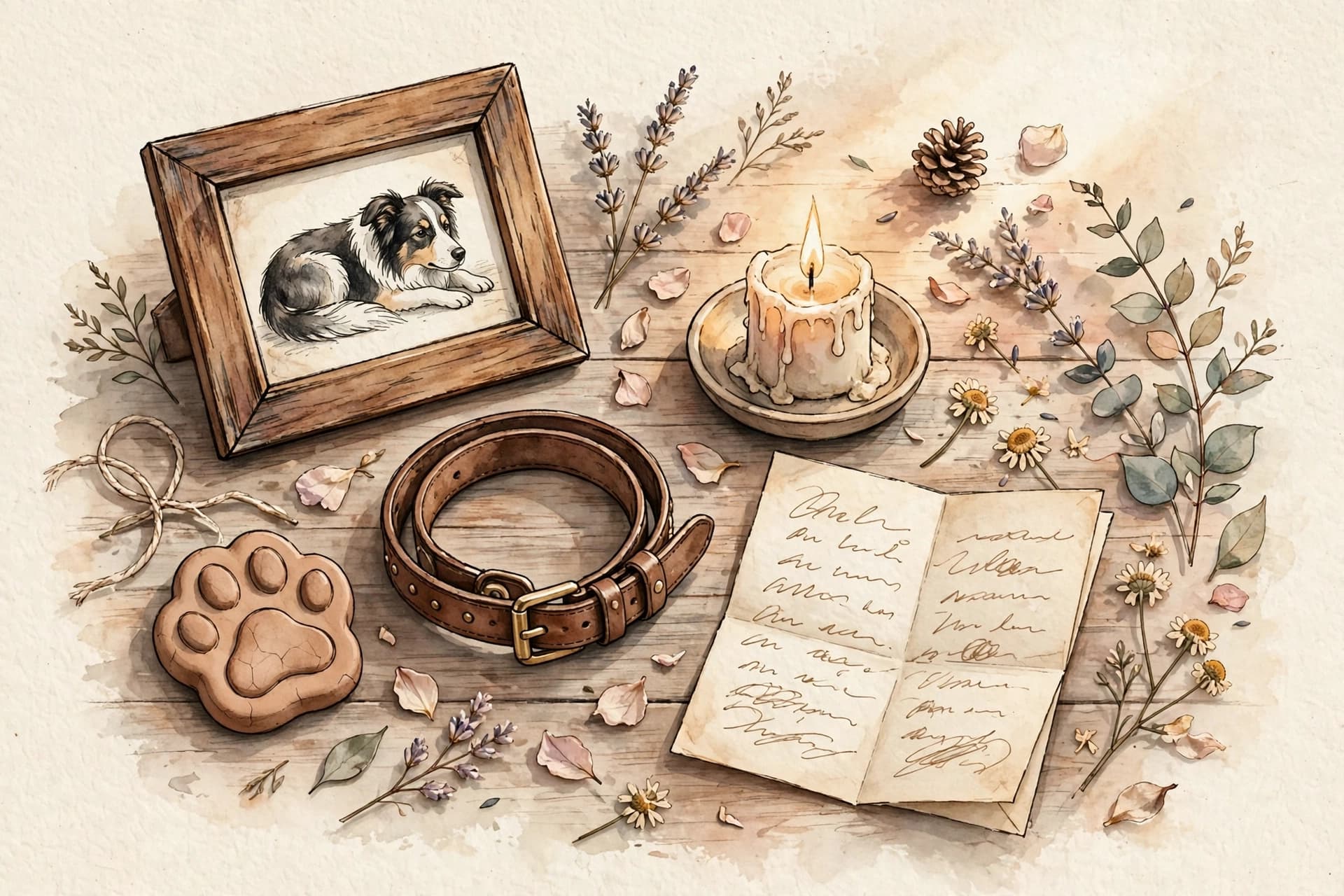
A memorial corner is a small, deliberate place in your home that holds your pet's memory: a framed photo, their collar or tag, a candle, perhaps their ashes in an urn you chose with care. It gives grief an address. Instead of ambushing you from every room, remembrance has a home you can visit.
There is no correct design. Some people keep it on a bookshelf for a season, then move the photo into the family wall and store the rest. Some keep it permanently. If you want more formats and wording ideas, our collection of pet memorial ideas has twenty, most of them free.
What keepsakes can be made from ashes or fur?
Jewellery is the most common modern keepsake: a small amount of ashes or a lock of fur sealed into a pendant, ring, or bead. Glass artists can swirl ashes into a paperweight or ornament. Some services press ashes into stones or incorporate them into a tattoo ink.
Ask your crematorium what they offer before the cremation, not after, because options like a fur clipping or paw print are only available at that point. These objects do not fix grief. They give your hands something to hold while it moves.
Can art and nature hold a pet's memory?
Yes, and for many people they hold it best. A commissioned portrait, painted from your favourite photograph, turns one image into something made slowly and deliberately in your pet's honour. Owners often say the wait for the portrait, and the conversations with the artist, are part of the healing.
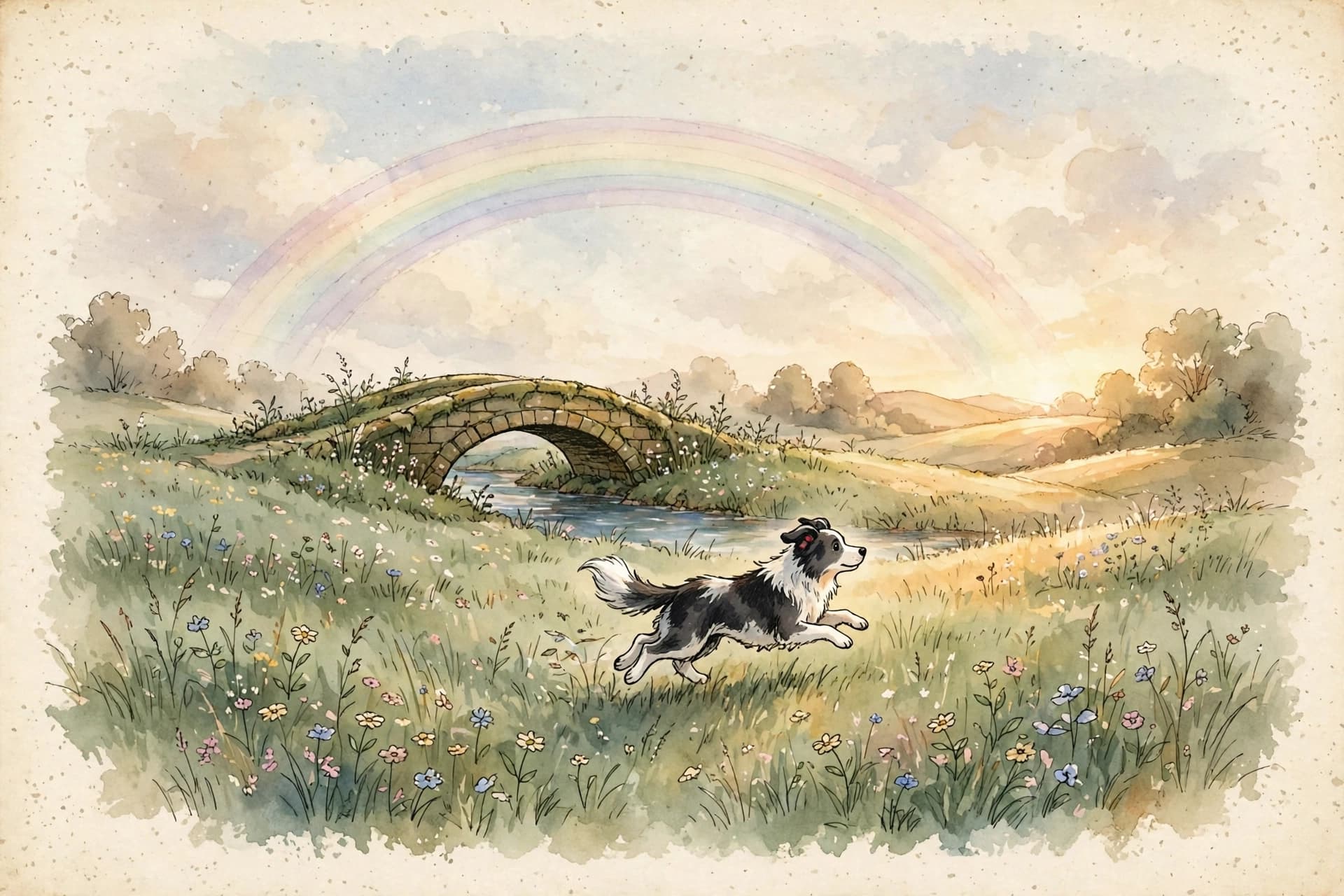
Planted memorials grow instead of sitting still: a tree, a rose bush, or a small garden corner where ashes can be scattered or buried under a stone with their name. Watching something living continue, season after season, suits people who find objects too static. The famous poem in our article on the Rainbow Bridge poem is often read at these small private plantings.
What are digital memorial pages?
Digital memorial pages are online spaces dedicated to one pet: a page with their photo and room for family and friends to leave messages. Some are hosted by memorial websites, others are simply a kept social media account, a photo album shared with family, or a page on a site of your own.
Their strength is gathering. The people who loved your pet from a distance, the dog walker, the vet nurse, the friend in another country, can all stand in the same place and say so. Their weakness is dependence on a platform, so keep your own copies of anything precious.
Before you choose a platform, check three practical things: who can post on the page, whether it can be made private, and what happens to it if the site closes or changes hands. A page that anyone can find may bring kind messages from strangers, and also messages you did not ask for. Download the photos and messages every few months, so the page is a gathering place, not the only copy of anything precious. If the platform ever disappears, your memories should not disappear with it.
What are modern digital keepsakes?
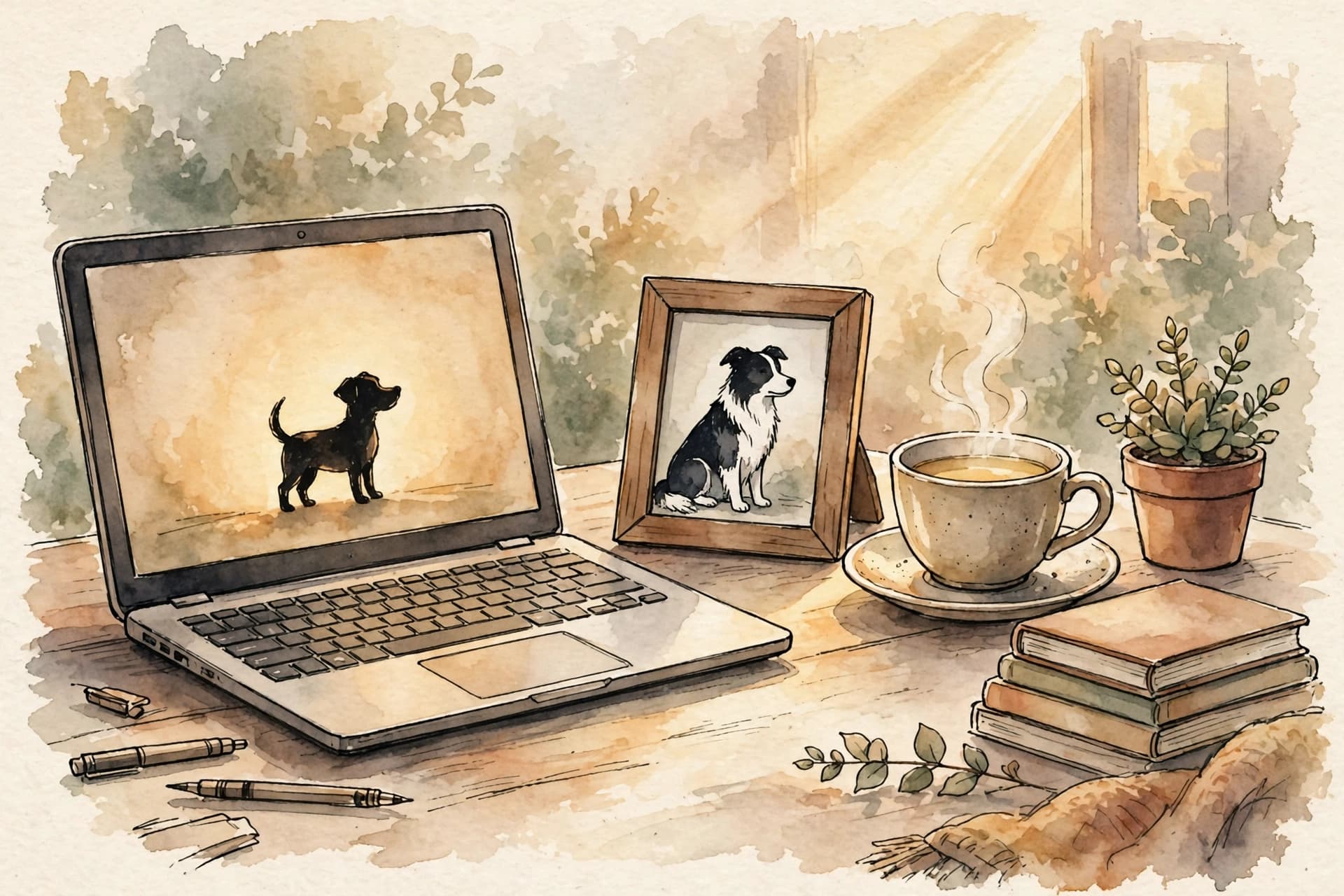
The newest category keeps not just an image of your pet, but a sense of their company. One example is StayWith, at staywith.pet. You provide a few photos of your cat or dog, and they are used to create a small 3D version of your pet that lives on your Mac desktop. It walks along the Dock, curls up on your open windows, and keeps you company while you work, in the loose, everyday way a pet does.
StayWith is also made for living pets, as a small tribute to a companion who is still very much here. For pets who have died, it has a memorial mode with gentler wording and behaviour. It will not suit everyone, and it is not a substitute for the photos, rituals, and time above. It is one more honest option on the spectrum: a presence, on the screen you look at all day.
How do you choose what is right for you?
Choose by feeling, not by obligation. Print one photo this week. If it comforts you, build from there. If a keepsake idea makes you uneasy, skip it without guilt; grief has enough rules imposed on it already.
You are also allowed to change your mind. Many people keep everything at first, then gradually keep less, and that softening is itself a sign of healing, not betrayal. And if your pet is still alive and you are reading ahead, the best preparation is gathering: take the videos and photos now, the way our dog bucket list suggests, one photo and one video at a time.
What if a keepsake starts to hurt instead of help?
Most keepsakes comfort, but sometimes one stops working. A photo that once made you smile now only makes you cry. A collar by the door that once felt like company now feels like an accusation. That change does not mean you are grieving wrong, and it does not mean the keepsake has failed. It usually means your grief has moved, and the object needs to move with it.
Try putting the item away for a while rather than getting rid of it. A drawer, a box on a high shelf, a pause of a month. Many people find the same object comforts them again later, once the sharpest pain has softened. Rotating keepsakes helps too: the photo on the wall this season, the collar in the drawer, the ashes on the shelf. Nothing has to be on display all the time to matter.
If an object makes you feel stuck, looping the same painful thought every time you see it, talk to a grief counsellor about it. They can help you tell the difference between a bond that comforts and a habit that keeps you circling, and that distinction is worth getting right.
How do you keep a pet close when you move house or travel?
Moving house is one of the hardest moments for a grieving owner, because the place itself held the memories: the sunny spot, the garden corner, the worn patch of carpet by the door. Take the memorial with you deliberately, not as an afterthought. Pack the photo, the collar, the urn yourself, in a box you carry, and set the new corner up on the first day, before the boxes are unpacked. A familiar object in an unfamiliar room makes the new house feel like yours faster than anything else.
For travel, small and portable works best: a photo on your phone background, a pendant with a little fur, a printed photo tucked in a bag. Some people keep a short video on their phone for the nights away from home when the missing feels sharpest. And if you are moving to a home where a new pet will eventually join you, that is not a betrayal of the old one. The new house can hold both the memory and the future, and the memorial corner can stay exactly where you put it.
Frequently asked questions
Is keeping my pet's ashes at home normal?
Yes, completely. Many owners keep ashes at home in an urn, scatter them later at a favourite place, or divide them between keepsakes and scattering. There is no deadline, and keeping them indefinitely is a valid choice.
How long should I keep my pet's belongings out?
As long as they comfort you more than they hurt. There is no schedule. Most people tidy things gradually, keeping a collar or blanket long term, and that slow pace is healthy, not stuck.
What if my family thinks I am grieving too much or too long?
This is common, because people grieve at different speeds. Share the idea of continuing bonds with them if it helps, and remember that the depth of your grief reflects the depth of the bond, not a problem with you.
Are digital keepsakes appropriate for a pet who is still alive?
Yes. Many people make portraits, albums, and digital tributes for living pets simply to celebrate them. Doing it now, while you can take fresh photos and videos together, usually produces the keepsakes people treasure most later.
What is the simplest first step to keep my pet close?
Print one photograph and put it where you will see it daily. It takes ten minutes, costs almost nothing, and for a great many people it turns out to be the keepsake that does the most.