Grief and the First Days · 8 min read · October 25, 2026
By the StayWith team
Guilt After Your Dog Dies Suddenly: The 'What If' Loop
When a dog dies suddenly, guilt arrives fast and stays loud: what if I had noticed, what if I had gone to the vet sooner, what if I had done something different. Vets who see sudden death regularly say the hardest truth is also the kindest one. In many cases there was nothing to notice, because the cause was hidden inside the body and showed no signs at home.
Why do I feel guilty when it was not my fault?
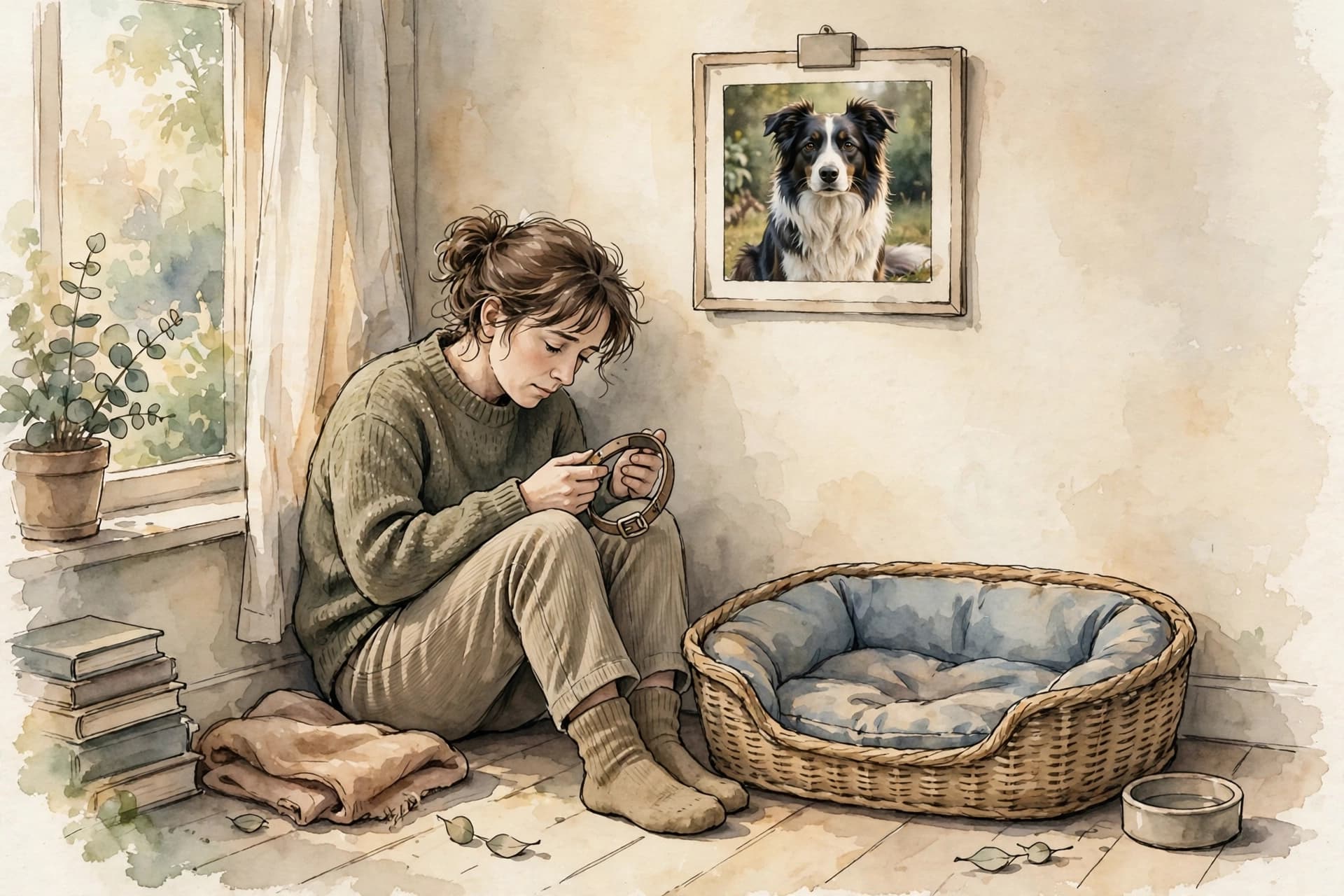
When a dog dies suddenly, the guilt usually arrives before the grief has even settled. What if I had noticed something? What if I had taken them to the vet last week? What if I had fed them differently, walked them less, stayed home that morning? The loop can run for weeks. Here is what vets say, and what grieving owners eventually learn: in many sudden deaths there was nothing to notice. Hidden heart problems, internal bleeding, and other silent conditions often show no warning signs at home, and no different choice on your part would have changed the outcome.
Guilt after a sudden death is not a verdict on what you did. It is your brain trying to find control in a situation that had none. A sudden loss feels random, and randomness is unbearable, so the mind invents a cause: something I did, something I missed, something I should have known. If there is a cause, there is a lesson, and if there is a lesson, the world feels safer again. That is the bargain your brain is offering you. It is not evidence. It is grief looking for a handle.
This is also why the guilt often feels stronger than the grief in the first days. Grief says "they are gone." Guilt says "and it is your fault." The second sentence is louder because it comes with a job to do: replay, investigate, blame.
The guilt can also be unfinished business wearing a disguise. Many owners never got to say goodbye, and the mind turns that unfinished feeling into blame, because blame feels like something you can fix. You cannot fix a goodbye that never happened, but you can finish it in another way: write the goodbye down, say it out loud at the place they loved, or tell a friend what you wish you had said. The guilt often loosens once the goodbye has somewhere to go.
What actually causes a dog to die suddenly?
The most common causes vets point to are things that hide well. A heart rhythm problem can kill a dog that seemed perfectly healthy that morning. An undiagnosed heart condition, especially in larger breeds, can cause collapse with no warning. Internal bleeding from a tumor that has been growing silently, most often on the spleen or heart, can cause a dog to fade in minutes. Bloat, a twisted stomach, can turn fatal in hours. A stroke or a blood clot can do the same. VCA Hospitals notes that sudden death in dogs is most often traced to heart disease or internal bleeding, and that many of these conditions show no signs an owner could spot at home.
This is the part worth sitting with. Your dog was not sending signals you ignored. Most of these conditions are invisible until they are not, and when they surface, they move too fast for even a vet in the room to stop them.
How do I talk to my vet about what happened?
Your vet is the one person who can answer the question properly, and most owners never ask. Call the clinic and say plainly that you want to understand what happened. Ask what the vet saw, what they think the cause was, and whether anything you describe would have changed the outcome. Vets answer this question often, and they will not soften the answer to spare you. Hearing "no, nothing you did would have changed this" from the person who examined your dog carries more weight than the same words from anyone else.
Ask for a copy of the records too. The notes from the last visit, the blood work, the weight chart. Reading them later, on a calm day, can settle the questions that the first week keeps shouting. If the answer is still unclear, a second opinion is fair to ask for, and a good vet will not be offended. Some owners also ask whether a necropsy would have helped. It can name the cause, but it cannot undo the death, and most owners who skip it do not regret skipping it.
What if I missed a sign?
Ask the question properly, and it usually answers itself. What exactly did you see that worried you at the time? Most owners, asked honestly, say nothing. The dog ate breakfast, went for a walk, slept in their usual spot, and then something happened. If you did see something small, a slower walk, a skipped meal, a night of restlessness, ask what you did with it. Most owners did what any loving owner would do: watched, waited a day, and planned to call the vet if it continued. That is reasonable care, not neglect.
Hindsight is a dishonest witness. It knows the ending and pretends the signs were obvious. They were not obvious, because you were living an ordinary day with a dog you knew well, and nothing about that day said "this is the last one." If you want to check your memory against the facts, our guide on when there is no goodbye explains what sudden death usually looks like from the vet's side.
How do I stop replaying the last day?
You cannot stop the replay by arguing with it. You can only change what you do when it starts. A few things that help owners:
- Write down the last day, once, in full. What time they woke, what they ate, where they slept, what you did together. Then when the loop starts, read the page instead of rebuilding it. The written version does not grow worse each time you tell it. The version in your head does.
- Answer the "what if" out loud, with facts: "What if I had gone to the vet on Tuesday?" "They would have run blood work and found nothing, because the problem was in the heart, not the blood." It sounds blunt. Blunt is what the loop needs.
- Talk to your vet. Ask them directly whether anything you describe would have changed the outcome. Vets answer this question often, and they do not soften it out of politeness. Hearing "no" from the person who examined your dog carries weight.
- Give the loop a time and a place. Set ten minutes in the evening, with a cup of tea, to think about the last day on purpose. When the thoughts come at other times, tell yourself they have an appointment later. It sounds strange, and it works more often than arguing with the thoughts does. The loop wants your attention, and giving it a small, fixed slot takes away its power to interrupt everything else.
When does guilt become something that needs more support?
Guilt that comes in waves and slowly gets further apart is normal grief, and it usually eases over weeks and months. Guilt that stays at full volume, or guilt that starts running your life, deserves help. The signs to watch for: you cannot sleep for more than a few weeks, you have stopped eating or leaving the house, you feel you do not deserve comfort, or you catch yourself thinking your dog would be alive if you were a better person. None of those thoughts are true, and all of them are common, but common does not mean you have to carry them alone.
A counselor who understands pet bereavement can help separate real responsibility from grief's version of it, and that separation is often the turning point. If guilt is the part of grief that is hurting most, our guide on euthanasia guilt covers the same loop from the other side, and much of it applies here too.
What if the guilt is about a decision I made that day?
Sometimes the loop is not about a missed sign. It is about a choice you actually made: you went for the long walk, you gave the extra treat, you stayed late at work, you skipped the vet visit because the dog seemed fine. That guilt is harder, because the choice was real.
Here is the test that helps. Ask yourself what a good owner, knowing only what you knew at the time, would have done. Not what you know now, with the ending in hand, but what you knew that morning. A good owner takes the dog for a walk. A good owner gives the treat. A good owner stays late at work when the dog seems fine. If your choice passes that test, it was a normal choice, and the outcome does not turn it into a mistake. A decision made with love and ordinary care is not a failure just because the day ended badly. If your choice does not pass the test, that is still not a reason to punish yourself for months. It is a reason to be honest about it once, to a friend or a counselor, and then to let the honesty do its work.
Frequently asked questions
Is it normal to feel guilty when the vet said it was not my fault?
Yes. The vet is giving you a medical fact, and your feelings are running on a different track. It can take weeks for the fact to catch up with the feeling. That lag is normal, not a sign you are broken.
Should I have asked for a necropsy?
Only if you need the answer for your own peace. A necropsy can sometimes name the cause, but it cannot undo the death, and declining one is a normal choice.
What if my dog died while I was away?
That guilt is especially sharp, because absence feels like a choice. It was not a choice. Dogs do not keep a ledger of which hours you were in the room. They keep the years. The years are what they carried.
Will I ever stop wondering what happened?
The wondering usually softens into an occasional question rather than a constant one. It helps to write down what the vet said and keep it somewhere you can find it on bad days.
Is it okay to still feel guilty months later?
Yes, especially around anniversaries, birthdays, and the first holidays without them. If the guilt returns, it usually passes faster each time. If it returns at full strength every time, that is worth talking to someone about.