Grief and the First Days · 8 min read · October 23, 2026
By the StayWith team
How to Cope With Losing a Dog: What Actually Helps
To cope with losing a dog, start with three things: give yourself full permission to grieve, because this was a family member and not just a pet; rebuild your days slowly, because the empty routines are where the pain hits hardest; and talk to people who understand, whether that is one friend, a support group, or a counsellor. Owners who have lived through this loss point to the same practical comforts beyond that: reminders handled at your own pace, one small ritual, care for sleep and food, and knowing when grief needs professional support.
Why does permission to grieve matter so much?
Many owners sabotage their own grief with a judge in their head. He was only a dog. I should be over this. That voice is wrong on the facts. A 2026 study in PLOS One found that 21 percent of owners rated their pet's death as the most distressing loss of their lives.
Grief counsellors call pet loss a disenfranchised grief, meaning society does not grant it the recognition it grants other bereavements. You will probably not get leave, flowers, or a funeral. So the permission has to come from you: this was a real loss, and I am allowed to feel all of it. The deeper reasons the bond runs so far are laid out in why it hurts so much.
How do you rebuild routines after your dog dies?
Your dog structured your day: the morning walk, the meals, the evening settle. When those anchors vanish, time itself feels broken, and the empty hours are where grief ambushes you. The fix is not to fill every minute. It is to give the worst hours a new, gentle shape.
Expect the stages of grief to keep moving while you do this. A calm week followed by a terrible day is the normal pattern, not a sign you are back at the start.
- Keep the morning walk for a while, on the same route or a new one. Many owners find the walking itself heals, even through tears.
- Put one fixed point in the evening, the hardest time of day: cooking, a programme, a call with a friend.
- Return to regular meals and a regular bedtime earlier than you feel like it. Grief and exhaustion feed each other.
- Plan weekends loosely for the first month, because unstructured days are the loneliest.
What should you do about reminders around the house?
The bowl by the door. The lead on its hook. The dent in the sofa. Every owner faces the question of what to move, and the only rule that matters is pace. Some people clear everything on the first weekend and feel relief. Some keep the bed in its corner for a year and draw comfort from it. Both are coping well.
If you cannot decide, use the middle path: gather your dog's things into one box for now. Revisit it in a month, when decisions that felt impossible in week one often feel obvious, and a few items will earn a permanent place of honour.
Who can you talk to when others do not understand?
Find the people who use your dog's name. One friend who asks how it is today, really, is worth twenty who change the subject. If your circle cannot hold this grief, borrow one that can:
Talking works because grief shrinks when it is witnessed. The goal is not advice. It is hearing your dog's name said aloud by someone who understands.
It also helps to know that people grieve in different languages. Some people need to talk, and talk, and talk. Others need to do things: walk, build, clean, fix. Neither is wrong, and partners often speak different languages, which is why one can feel abandoned while the other feels crowded. If your partner grieves differently, name it plainly: I need to talk about him tonight, and I know you need quiet, so let us do both. The guidance for the wider circle is in what to say to someone.
- Facebook pet loss groups, where thousands of owners post memorials and answer each other at 3 in the morning. The AKC Pet Loss Support Group and The Rainbow Bridge Pet Loss and Grief Support group are two of the largest.
- The Association for Pet Loss and Bereavement (APLB), which runs free online chat sessions led by trained volunteers.
- Pet loss hotlines run by veterinary universities, staffed by people trained for this conversation.
- A grief counsellor who names pet loss in their practice. Many offer video sessions.
Which memorial rituals actually bring comfort?
Ritual gives grief a place to go. Owners consistently rate these as the ones that helped:
More ideas for every budget and living situation live in pet memorial ideas. Pick one ritual, not ten.
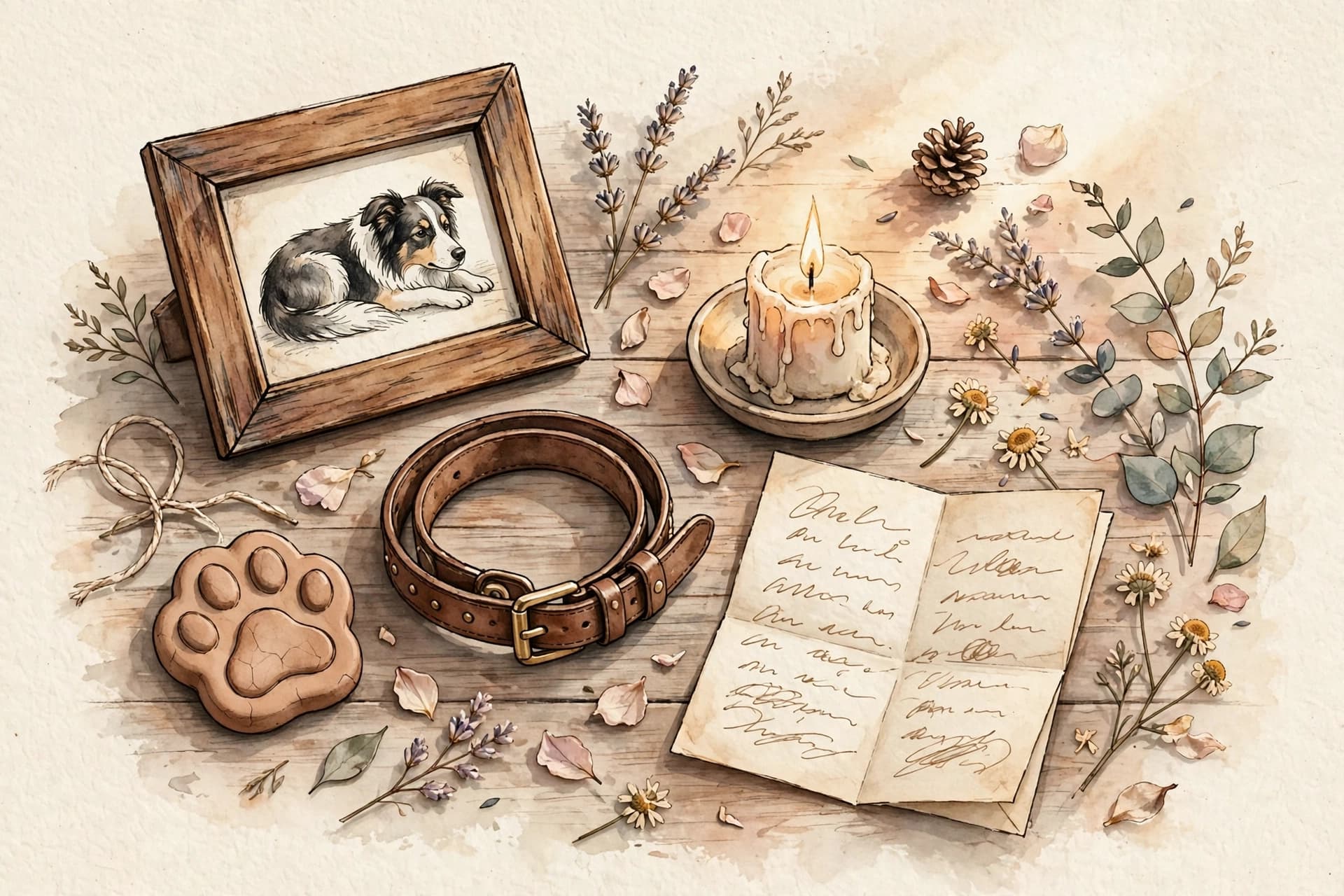
- Write a letter to your dog. Say the thanks, the sorry, and the goodbye the last day left no room for.
- Make one small ceremony: bury the ashes, plant a tree, or light a candle one evening a week for a month.
- Choose one keepsake to keep close, such as a framed photo in the room where you spend your evenings, a paw print by the door, or a digital keepsake built from your favourite photos of them, which is the idea behind StayWith.
- Tell their stories. At dinner, on their birthday, whenever they come up. A dog who is still spoken about is not entirely gone.
How do you look after your body while you grieve?
Grief is physical, and neglecting the basics makes the emotional side heavier. Some food at regular times, even just soup and toast; water within reach; daylight once a day; and sleep protected like medicine. If you wake at the hour you used to let your dog out, that is normal for a while. Bodies keep the schedule long after the mind knows.
Go easy on alcohol, which fragments sleep, and accept practical help when it is offered.
Sleep deserves its own mention, because grief breaks it in a specific way. Many owners wake at the hour they used to let the dog out, or lie awake listening for sounds that no longer come. A few things help: keep the bedroom cool and dark, avoid screens in the last hour, and get daylight early in the morning, which steadies the body clock. If you wake in the night, do not lie there fighting it. Get up, make tea, read for twenty minutes, then try again. If broken sleep lasts more than a few weeks and your days are falling apart, mention it to your doctor. Sleep is not a luxury during grief. It is the foundation everything else stands on.
When is coping not enough, and help is needed?
Most grief softens slowly on its own. Reach for professional support when the picture looks different: the intensity stays at its peak for many months with no softer days; you cannot work, sleep, eat, or care for yourself; you feel persistent numbness or hopelessness; or you have thoughts of harming yourself, which should be treated as urgent today.
About 7.5 percent of bereaved owners may develop prolonged grief, where the loss stays raw far beyond the usual arc set out in how long does grief last. It is not a character flaw, and it responds to treatment. Start with your doctor or a grief counsellor, and be as honest about the dog as about any other bereavement.
What do you do on the hard days that come back months later?
Expect them. Grief arrives in waves, and a wave can still knock you down in month six after months of calm water. A song, a season, a dog on the street that looks like yours, the anniversary, or nothing at all. A bad day months later is not a relapse. It is the normal shape of grief, and the waves get shorter even when they still feel tall.
Keep a small wave plan ready for those days, so you do not have to think when thinking is hard. One person to call, and their number saved where you can find it. One walk, the same route or a new one, taken even through tears. One small ritual: light the candle, look at one photo, say their name out loud. Then one ordinary thing: a meal, a shower, a short task finished. The wave will pass, as every wave before it has, and the next one will usually be a little further away.
How do you keep your dog's memory alive without staying stuck?
Grief researchers call this continuing bonds, from work by Klass, Silverman and Nickman in 1996. The healthy form of grief is not letting go of the bond. It is changing it, from a daily presence into a lasting place in your life. Talking about your dog, marking their birthday, keeping their photo where you can see it: these are not signs you are stuck. They are how love continues after death.
The difference between remembering and ruminating is worth knowing. Remembering brings warmth alongside the sadness: a funny story, a favourite walk, the way they sighed before sleep. Ruminating replays the worst day on a loop, usually the last day, and asks the same unanswerable questions. If you notice yourself replaying the death itself rather than the life, that is a sign to talk to a counsellor, not a sign you are failing. More ways to keep the bond alive, from the simple to the lasting, are gathered in keeping your pet close. Pick one, not ten, and let it be enough.
Frequently asked questions
What is the fastest way to cope with losing a dog?
There is no fast way, and chasing one usually backfires. What shortens the hardest phase is structure: permission to grieve, gentle routines, people who listen, and one ritual. According to PetMD, acute grief typically lasts 1 to 2 months before softening into waves.
Is it normal to cry every day after losing a dog?
Yes, especially in the first weeks, and it usually spaces out over the first few months. Crying is not the problem to solve. It is grief leaving the body in instalments.
Should I stay home from work after my dog dies?
If you can take a day or two, many owners find it helps, because concentration and tears do not mix in public. Pet loss rarely qualifies for bereavement leave, which is part of why this grief is called disenfranchised. A leave day used honestly is reasonable self care.
How do I cope when my partner grieves differently?
Expect different speeds and styles, and do not grade each other. One of you may need to talk; the other may need silence. Agree on two things: the dog's name stays welcome in the house, and neither of you sets the other's timeline.
Will the pain of losing my dog ever go away completely?
For most owners it changes rather than vanishing. The raw pain fades across the first year for the majority, and what remains is a tender spot: real sadness, woven with gratitude and stories.