Grief and the First Days · 8 min read · October 23, 2026
By the StayWith team
What to Do When Your Dog Dies: The First 24 Hours
When your dog dies, you have more time than it feels like you do, and only a few things truly need to happen in the first 24 hours. Confirm your dog has died, keep their body somewhere cool, call your vet or a pet crematorium to arrange what comes next, and ask for keepsakes such as a paw print and a clipping of fur before any cremation or burial takes place. Everything else, including decisions about belongings, can wait. This guide walks through the day step by step.
What should you do first if your dog dies at home?
Take a breath and slow down. It can be hard to be sure in the first moments. Look for breathing, feel for a heartbeat on the chest just behind the front leg, and watch the eyes, which usually stay open. If you cannot tell, call your vet or an emergency vet line and let them guide you. Nothing bad happens if you take ten minutes to sit with your dog first.
Then, when you are ready:
You do not need to rush the body anywhere. In a cool room, you generally have the rest of the day to make arrangements.
- Place a towel or blanket under your dog, as the bladder and bowels can release.
- Close the mouth gently if you wish, and arrange the body in a resting position, on the side, as if sleeping.
- Move other pets away if they seem distressed, or let them sniff and understand if they are calm.
What happens if your dog dies at the vet?
If your dog dies at the clinic, or is put to sleep there, the staff will usually ask what you would like to do about the body. The common options are to take your dog home for burial where the law allows it, or to arrange cremation through the clinic. You can ask for time alone with your dog before deciding. Veterinary staff expect tears and slowness.
Ask the clinic about paw prints and fur clippings before you leave, even if you feel too numb to want them now. Owners who decline keepsakes in the first hour often wish for them later, and later they cannot be made.
Who should you call in the first 24 hours?
Keep the list short on day one. The practical calls are:
Telling other people is its own task. If children are involved, use plain words: our dog died, his body has stopped working, and he will not come back. Children handle plain truth far better than gentle evasions, and the full guidance is in explaining death to a child. If you need to tell your workplace, one short message is enough: my dog died and I need a day. You do not owe anyone the details. And the calls to the microchip company and the insurer can genuinely wait a few days. Put them on a list for next week, not for today.
- Your vet, if your dog died at home, to record the death and discuss cremation or collection.
- A pet crematorium, if you prefer to arrange things directly.
- Your microchip company and insurer, which can wait a few days.
- One friend who can tell others for you, so you do not repeat the news ten times.
How should you care for your dog's body in the first hours?
Keep the body in the coolest room available, away from heaters and direct sun, resting on a blanket. You can cover your dog with a favourite blanket, leaving the face visible if the family wants to say goodbye. Some stiffening is normal within a few hours.
If arrangements will take until the next day, a garage or cool outbuilding is commonly used, and you can place ice packs, wrapped in cloth, alongside the body. If children will see the body, prepare them with plain words first: he will look asleep, but he is cold and will not wake up, and that is what death means.
Should you choose cremation or burial for your dog?
Both are loving choices, and the decision usually follows your home, your local rules, and your instinct about the place you want to visit.
Burial at home is allowed in some areas and restricted in others, and renters usually cannot use it. Where it is allowed, the grave should be deep, well away from water sources, and in a spot that will not be disturbed. Some owners choose a pet cemetery instead, which gives a permanent marked place.
Cremation comes in two main forms. Communal cremation means several animals are cremated together and ashes are not returned. Private cremation means your dog is cremated alone and the ashes come back to you in an urn or scatter tube.
What affects the cost of cremation or burial?
Prices vary widely by region, so ask for a full quote before you agree. The main factors are:
Ask one direct question: what is the total, including collection and the urn? Reputable services answer plainly.
- The size and weight of your dog.
- Communal versus private cremation, with private costing more.
- Collection from your home versus you bringing your dog in.
- The urn or casket you choose.
- Extras such as paw prints or a farewell room, plus any out of hours collection fees.
What keepsakes should you ask for before it is too late?
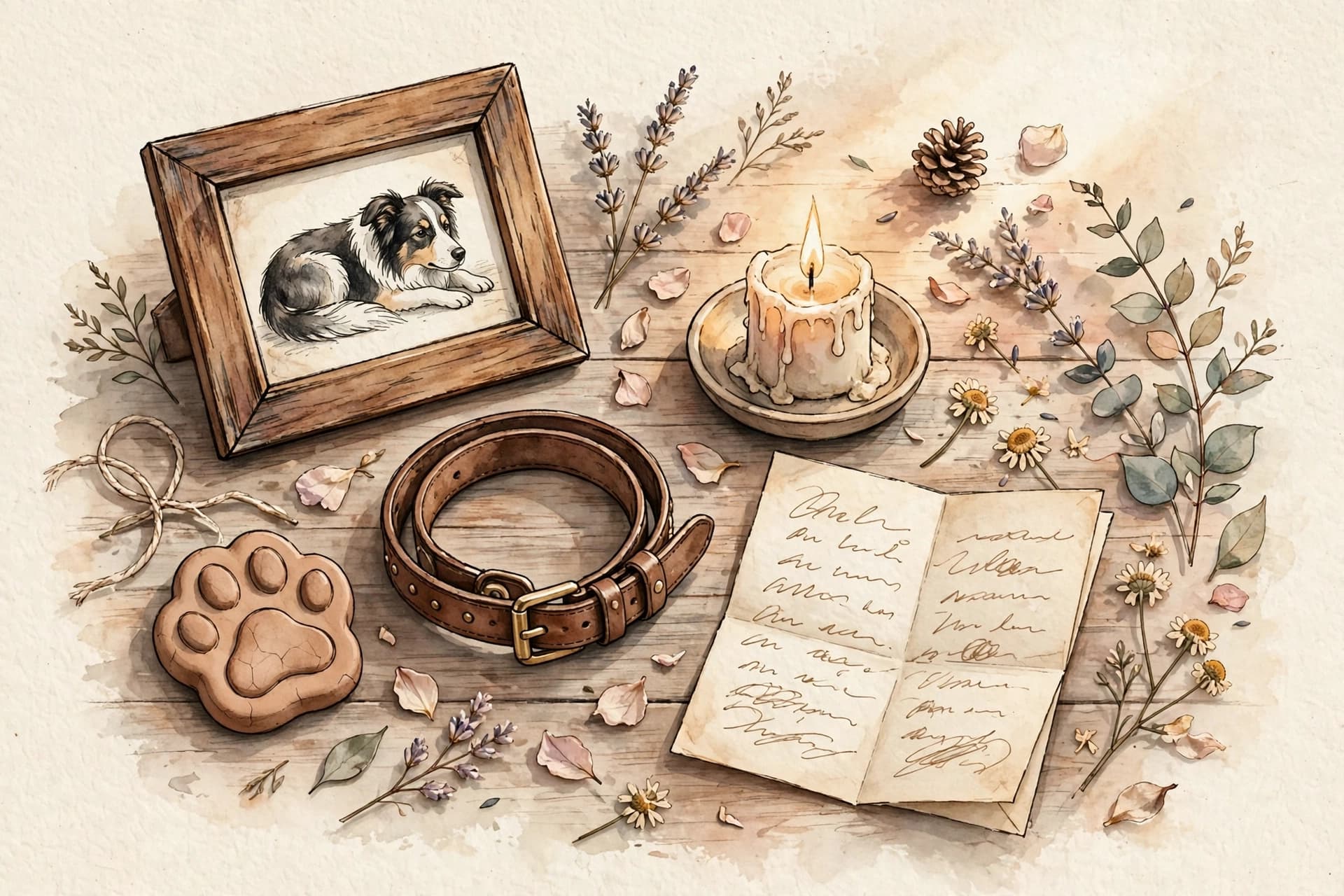
Ask early, because these can only be made before cremation or burial:
For later, when the first days have passed, pet memorial ideas gathers the memorial ideas owners say genuinely helped. There is no deadline on remembering. There is only a deadline on these physical keepsakes.
- A clay or ink paw print, or a nose print, which many owners treasure most.
- A clipping of fur, kept in a small envelope or locket.
- The collar and tag, returned to you cleaned.
- A photograph of your dog at rest, if that brings you comfort.
What should you do with your dog's belongings in the first days?
Nothing rushed. This is the advice owners pass to each other most: do not clear the house on day one in an attempt to feel better. Move the bed, the bowl, and the toys only when moving them feels like care rather than erasure. Some people wash nothing for weeks because the smell is still there. Some move the empty bed the same night. Both are right.
A middle path many people like: gather everything into one box or one corner for now. Decisions about donating food can wait a month. The longer work of living in the changed house is covered in coping with losing a dog.
The collar often becomes the most treasured object, so decide about it deliberately rather than in a rush. Some owners keep it on the hook for a year. Some put it in a memory box with the tag and a photo. Some donate the food, the spare lead, and the unopened treats to a shelter, and find that giving those things a second life feels like a kindness rather than a loss. There is no deadline on any of this. The box can wait in a cupboard until the day you open it and feel ready.
What should you do if your dog dies while you are away?
This is one of the hardest ways for it to happen, because you were not there. Usually someone else, a vet, a friend, a sitter, or a family member, has to handle the body, and you have to make decisions over the phone while your head is somewhere else entirely. The guilt can be fierce: I should have been there, I should have known, I should not have gone.
Start with what can still be done. Ask the person with your dog to keep the collar and tag, and to ask the vet for a paw print and a fur clipping if that is possible. Ask them to tell you plainly what happened, so you are not left imagining worse versions. Then give yourself permission to grieve the absence as well as the death. You are grieving two things: the dog, and the goodbye you did not get.
Coming home is often the hardest hour. If you can, do not come home alone. Ask someone you trust to be there, and decide in advance about the most painful sight, usually the empty bed. Some owners ask a friend to tidy it away before they arrive. Others want everything exactly as they left it. Either choice is right, and the right one is the one you choose, not the one someone else chooses for you.
What paperwork should you sort out in the first week?
None of this is urgent on day one, and all of it can be done one small call at a time across the first week.
One short list, one call a day. The vet's office can tell you exactly which of these apply in your area, so you do not have to research it yourself.
- Tell the microchip company, so the chip is marked and no one can claim your dog later.
- Call your insurer, either to claim for the final vet bills or to cancel the policy. Keep the vet receipts in one envelope.
- Ask your vet for a copy of the records, including the cause of death if it is known. You may want them later, for a new dog or for your own peace of mind.
- If your area has a dog licence, cancel or update it so you are not charged for a dog who is gone.
Frequently asked questions
How long can I keep my dog's body at home before cremation?
In a cool room, the same day or the next day is fine, and most families choose one of those. Heat speeds changes in the body, so in warm weather, aim for the same day and use ice packs wrapped in cloth alongside the body.
Can I bury my dog in my garden?
It depends on your local rules, which vary by council and country, and on whether you own the property. Where burial is allowed, dig deep, stay away from water sources, and pick a spot unlikely to be disturbed. If unsure, cremation avoids legal problems later.
Should I let my other dog see the body?
Many behaviour specialists say yes, if the other dog is calm. A brief chance to sniff the body can help a surviving pet understand, and some owners report less searching afterwards. If either animal seems distressed, separate them and do not force it.
What should I say when I call the vet?
Plain words are enough: my dog has died at home, and I need help with what happens next. The team handles this call often and will ask about cremation or collection, size, and timing. You do not need to hold yourself together.
Is it normal to want to keep my dog's ashes at home?
Yes, very common. Many owners keep the urn in a place of honour, or scatter some ashes at a favourite walk. There is no deadline here. Decide when your heart is quieter, not on day one.